|
President Jack called the meeting to order a little early because we had a lot to cover in our meeting. Melanie Dart gave a moving invocation after telling us about her Rotarian-father’s devotion to the principles in Rotary’s Four-Way Test. We sang “America the Beautiful” as our patriotic song. Lisa Smith ferried the microphone to several Rotarians with guests; including guests who were prospective members of the club. Teresa Kmetz’s Remembrance Report was that “The health of the Club is Good” including the good news that Todd Terwilliger had a son, born July 16. “Undoubtedly a prospective Rotarian.”
President Jack presented a Red Badge to new member Paul Danker, Mortgage Banker with Chemical Bank. New member, Rich Howard, gave his New Member Presentation, accompanied at several points by John Dale Smith on the Kurzweil piano. (We wondered why John Dale played the theme from The Muppet Show when Rich approached the microphone. We found out they had been friends for a dozen years.) Rich sojourned from his birthplace of Hastings to Lansing Community College, to MSU for a master’s in counseling, which comes in handy in his role as a licensed professional counselor and head of Big Brothers Big Sisters. Rich has worked with many Lansing Rotarians over the years and now is very happy to be in a position where the children who simply need a caring adult in their lives can get that relationship. Rich got his Red Badge once President Jack remembered to give it to him. There were unsolicited endorsements from the audience for Rich and the work he does. Welcome to the club Rich.
President Jack complimented Lansing Rotary on its success with several big projects over the years, like the Centennial year and its major donation to Impression Five’s Water Room. He introduced Club member Al Yambor who told us about the serious need for additional bathrooms and showers at the Canica orphanage in San Marcos, Guatemala. That’s an international project that Rotary is undertaking after the nomination by a Rotarian. Al Yambor provided photos of the project’s progress that were found at each table. Jen Duby, current chair of the club’s International Committee finds serving on that committee to be inspiring. While children in the U.S. go to school in buildings, children in South Sudan walk miles to attend school under a tree. While sitting on the ground. In scorching heat. While Rotary hasn’t yet built a school, Lansing Rotary’s grant of $750 went for desks and pencils and other basic supplies, for which the children and community in Majok-Chedhiop, South Sudan are extremely grateful. These two reports were given to remind Lansing Rotarians that anyone in the club can nominate an international project to be considered for a grant. $30,000 last year was divided between six different projects. International Committee members help guide every member’s nominated project through the process. Please contact Jen or any member of the International Committee if you have questions or an idea for an international project.
Our special music, introduced and accompanied by John Dale Smith, were two wonderful trumpet players. They played two great “show-offy” pieces that let their trumpet virtuosity shine. The first, by Vivaldi, was performed by Nik Buchholtz and MarkThompson. The second was a solo by Nik of a dramatic arrangement of the Carnival of Venice.
Chair of the Month, Curt Sonnenberg, introduced our speaker, Judge Thomas Boyd, of Ingham County’s 55th District Court. District court is where cases begin. Big problems move on to the circuit courts, “which is why circuit judges are always sad.” A district court judge’s role is to determine if someone has a problem or, if they simply made a mistake. “District courts are about rehabilitation and are looking for remedies.” If internal motivation doesn’t work to address people’s issues, judges have many tools to provide “motivation with a stick.” Or external motivation. Failure can mean death from an overdose or a deadly car crash.
Judge Boyd’s court has 28 employees, eight of whom are in probation, since rehabilitation is paramount. “Sobriety Court is for repeat drunk drivers – often it’s alcohol but there are more opioids today. Ingham County’s Sobriety Court (strongly backed by Lansing Rotary’s own, County Commissioner Rebecca Bahar-Cook) has graduated 530 people who have a ten-times better chance to not be a recidivist.” The Mental Health Court differs from Sobriety Court with its internal/external motivations and “stick” approach. That doesn’t work with mental health defendants because often life in jail is less chaotic than their life outside.
In the Mental Health Court three dedicated probation officers, four mental health counselors, and others who specialize in mental health issues determine what the person needs. “What’s missing that impedes this person’s rehabilitation? Transportation? CATA is a huge and important partner in this effort. Is there a need for parenting skills? Community Mental Health has programs for that as well as for many other deficits people may have. The Mental Health Court has a 60-person capacity. There are 59 people going through the rehabilitative process today. Required visits are tapered in number from weekly to once every three months. The carrot and stick approach makes jail a possibility, but encouragement and recognition as well as perks or small prizes are the carrots. The people in the Mental Health Court processes are all ages, ranging from 17 years old to 57 years old. The most common age range is 17 - 25. They are more likely to be men than women. The majority have depressive disorders. Another large percent have bi-polar issues. Some are schizophrenic. Some suffer from post-traumatic stress disorder (PTSD).
Judge Boyd discussed the erroneous notions that the court system should be for “public safety” or that it should serve as a “cash cow.” He explained that 25% of the criminal cases in district court have been “driving while license suspended.” But a closer look shows that the majority of those citations are because a person has been unable to pay something. Not because of bad driving. The district court system was established in 1961 when the justice of the peace system proved to be corrupt because the peace justices got a “cut” of any fines they imposed. But a 2013 Michigan Supreme Court decision in “People v. Cunningham” gave district courts the authority to assess costs and has led to the perception that low level courts are “looking for money.”
President Jack thanked Judge Boyd for his remarks and presented the Rotary 4 Way Test coin and the acknowledgement of the donation, made in Judge Boyd’s name, to the Bio Sand Filter project for clean water in the Dominican Republic and Haiti. The meeting was adjourned just a minute or two after 1:30.
|


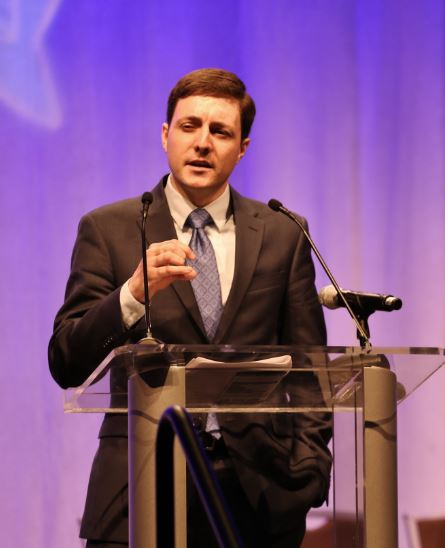 Sheehan is an attorney, a husband, a father, a Lansing native and a lifelong resident, with a fierce pride for the capital region and the people that make up this diverse and vibrant community. He currently serves as the Executive Director of the Lansing Promise and is the Chair of the HOPE Scholarship Board.
.bmp) Sign up now for the 16th annual Lansing Rotary Foundation Golf Outing!
Sign up now for the 16th annual Lansing Rotary Foundation Golf Outing!