|
Past-President Courtney, filling in for the traveling President Chris, opened the meeting with a ring of the bell. After leading us in the Four Way Test, she introduced Linda Sarnelli for our reflection, which focused on the meaning of truth. Our patriotic song was “My Country ‘Tis of Thee’ accompanied by Hari Kern at the piano. Sue Hansen was in charge of the microphone for the introduction of guests. Kurt Guter asked us to welcome Jackson Kaguri, who will soon be a member of our club. President Courtney announced that the DEI Committee would be meeting immediately after our regular meeting. It’s also not too early to commit to attending the 41st Annual Martin Luther King Jr. Brunch on January 19th. See Bilky Joda-Miller to confirm your seat at a table of Lansing Rotarians. Email for Bilky: bilky@allbodykneads.com Rebecca Bahar-Cook served as Chair of the Day and introduced Chuck Lippstreu, President of Michigan Agri-Business Association (MABA) as our speaker. After reviewing Chuck’s 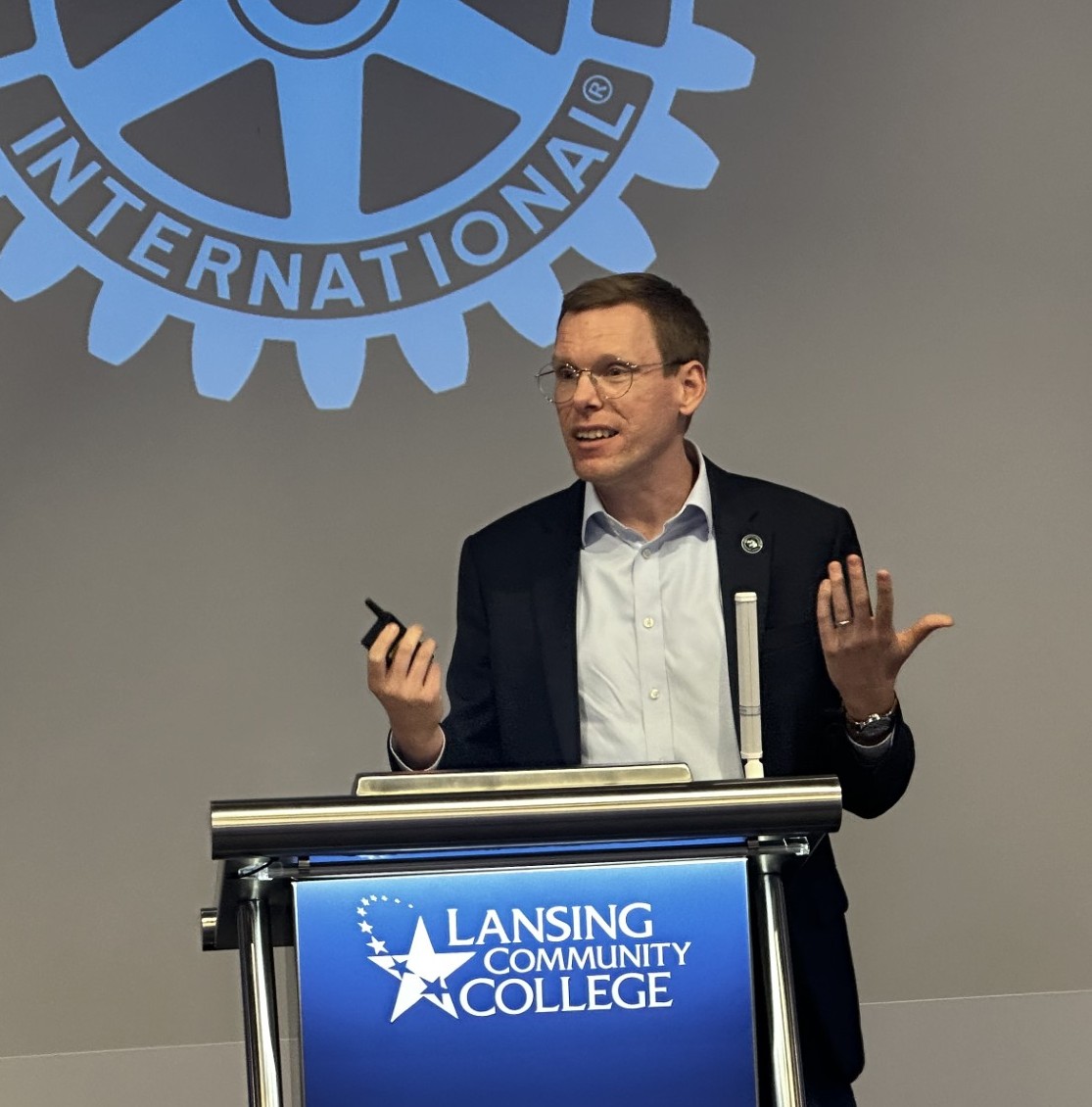 credentials, she related some experiences that he has arranged since Rebecca became an MSU Trustee. Most notably, she was able to climb into the cab of a very tall tractor and sample fermented soy beans, which she does not recommend. After letting us know that Monday would be Global Fertilizer Day, Chuck told us that agriculture is the second largest economic engine in Michigan. We are also the second most diverse agricultural engine, with California claiming the top spot. However, we have ample access to freshwater, while California has severe freshwater shortages. We grow over 200 different commodities, specialty fruits and vegetables, and have a wide range of livestock. This diversity provides a guardrail against volatility in the industry. Michigan has been able to benefit from consistent exports and a strong entrepreneurial spirit. We feed people on 6 continents. MABA is an advocate for and resource to the Michigan Agricultural Industry. Its 300 members are comprised of agriculture retailers, grain handlers, input manufacturers, logistics companies and service professionals. The organization keeps members apprised of issues affecting the industry, advocates for the industry, and provides networking and training opportunities. The industry needs a strong regulatory landscape, ensuring that the rules are the same across the entire country. There is significant uncertainty as the industry looks to 2026 and beyond. While livestock and dairy are looking okay, crop farmers are feeling a lot of pressure, especially if their crops are exported. Prices are falling as exports are drastically declining, creating recession conditions. On the upside, farm land is holding its value well. Exports are critical and needed for crop farmers to survive. We are headed for a record trade deficit in 2025 which is creating an oversupply, and we do not have sufficient storage capacity for all of the crops that will be harvested. Farmers are slowing their harvests if possible since there is no where for crops to go. The China market is non-existent at the moment and needs to be re-opened. The Trump administration is working to develop new markets and there is talk of a 12 to 13 billion dollar bail out. Technology will remain critical for agriculture. Use of technology leads to reduced use of pesticides, fertilizer and seed while still increasing production. Currently farmland produces 4 to 5 times the production of the 1930s and 40s. Other critical issues include labor, logistics, and land use discussions. Discussion during Q&A touched on recent actions of the Trump administration and its effects on agriculture. The elimination of USAID resulted in a loss of research funding the MSU as well as eliminating a market for crops. Some demand may be backfilled through other US government programs. When asked about immigration, Chuck would like to see a balance between immigration policy and the needs of agriculture. The need for labor is high, especially for specialty products. Immigrants are desperately needed for these jobs, which are difficult and cannot be filled with American labor. In addition to labor needs, conditions at the southern border can affect exports. In response to a question about the number of small farms that remain in Michigan, Chuck did not have the number in his head, but state that any dip in the agricultural economy leads to a further consolidation of farmland. President Courtney thanked Chuck for speaking to us. One last announcement was to let us know that the flowers on one of the back tables were in honor of Cathy Andrews birthday. We concluded the meeting by singing “Happy Birthday”. Email for Linda Lynch: linda.j.lynch@gmail.com |


 Cathleen Edgerly serves as the Executive Director of the Michigan’s Downtown with Lansing’s downtown management agency, Downtown Lansing Inc. Cathleen is a well-known community connector and leader in downtown advocacy, serving in rural and urban downtowns for the past 15 years. With this she adds extensive practitioner and presenter experience - sharing the powerful role placemaking has in economic development. In 2023 Cathleen was selected to be a part of a cohort of 20 downtown development professionals from around the country taking part in an intensive week-long fellowship program in NYC, where she earned her Downtown Leadership certificate from the International Downtown Association.