President Susan called the meeting to order at precisely 12:30 p.m. Because if there is one thing Susan is going to do, it is start Rotary on time.
We made our way through the Four-Way Test and then it was time for Bill Frysinger to give the reflection. Except there was one small problem.
Where was Bill?
MIA.
So, in a rare breach of Rotary procedure, we skipped right over him and moved on to our patriotic song, “My Country, ’Tis of Thee.”
We then welcomed our guests:
- Amy Partin introduced Tonya McClain, Interim Chief Diversity Officer with the Office of Empowerment at Lansing Community College.
- Hari Kern introduced Linda Covey, a retired counseling psychologist who now spends her time raising sheep and llamas out in Williamston. Which frankly sounds like a pretty great retirement plan.
- Steve Robinson introduced Angela Matthews, Chair of the Lansing Community College Board of Trustees.
- Bobby Hoffman introduced Carolyn McQuillan, Philanthropy Officer for Major Gifts at McLaren Greater Lansing Foundation.
- Bill Frysinger introduced his wife, Christine Frysinger.
- Joseph Yang introduced Nick Acosta from Modern Woodmen of America.
And somewhere along the way, Bill Frysinger did in fact make it to Rotary. Crisis averted.
Bill finally came to the front of the room for his reflection and started with three questions: Where do we come from? Who are our people? What are we? Bill talked about his own roots. He is from Ohio, has Dutch ancestry, and comes from generations of masons. His family moved across states, their faith evolved over time, and all of those people and experiences helped shape who he is today. He tied that into the Native American concept of thinking about seven generations — the generations who came before us and those who will come after us.
Bill reminded us that we are really just temporary custodians of the places we occupy. We should not take someone else’s culture and claim it as our own, but we absolutely can learn from it. His point was also a good reminder that getting outside of our own little corner of the world tends to make us better humans. Other people have their own experiences, beliefs and “self-evident truths.” Sometimes we all just need to give one another a little wiggle room. Or, as Bill put it in one of my favorite lines of the day: fear is for people who don’t get out very much.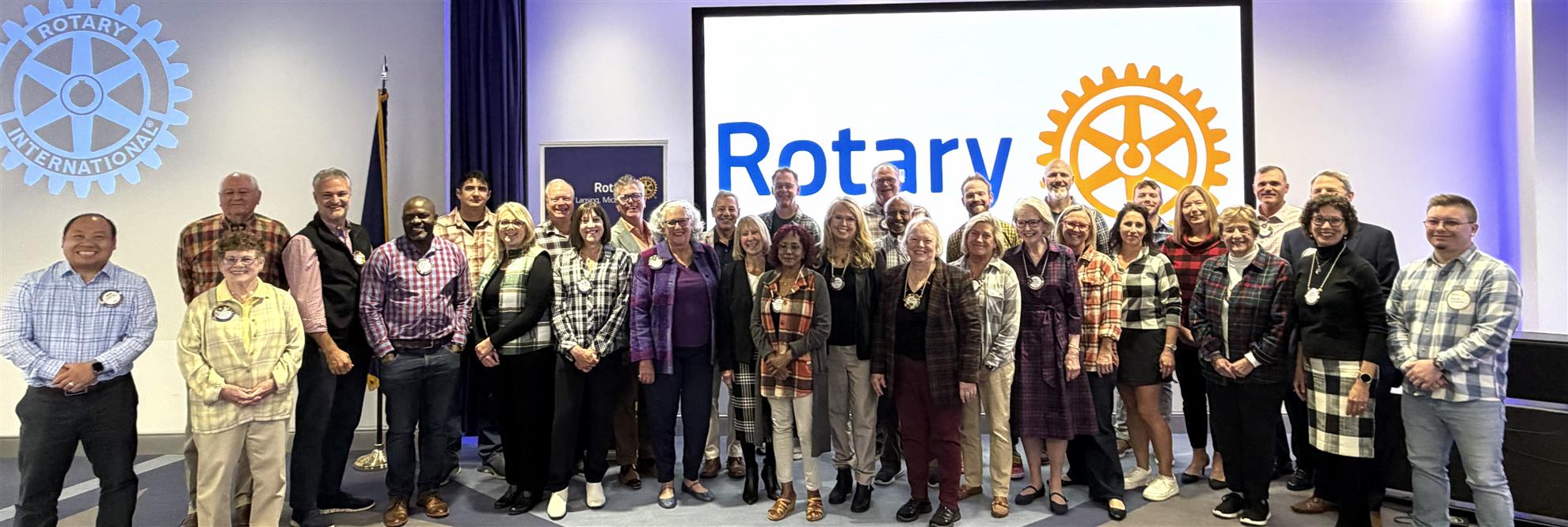
From there, we moved on to the very serious Rotary business of Plaidurday. Several Rotarians participated and wore plaid. Terry Terry then came forward with some genuinely big news: Lansing is officially the Jam Capital of the World! Lansing successfully completed the Guinness World Record for the world’s longest continuous jam session. So if anyone asks what Lansing is known for, you may now add “record-breaking quantities of jamming” to the list.
A group of Rotarians also volunteered at the Greater Lansing Food Bank on Tuesday, September 22. You can see photographic evidence of their good deeds elsewhere in the Rotogram.
Downtown Lansing Inc. is looking for volunteers for its Big Red Ball on Saturday, November 21. They need help with setup from 2:30–5:30 p.m., several shifts during the event between 5:30 and 10:00 p.m., and teardown and cleanup from 9:30–11:30 p.m.
Bill Frysinger then introduced our speaker for the day, John Ostrander, Executive Director of the Nokomis Cultural Heritage Center. Bill serves on our DEI Committee, which is selecting this month’s speakers, and said they thought a good place to begin was by learning about the culture and history of the people who were here long before the rest of us.
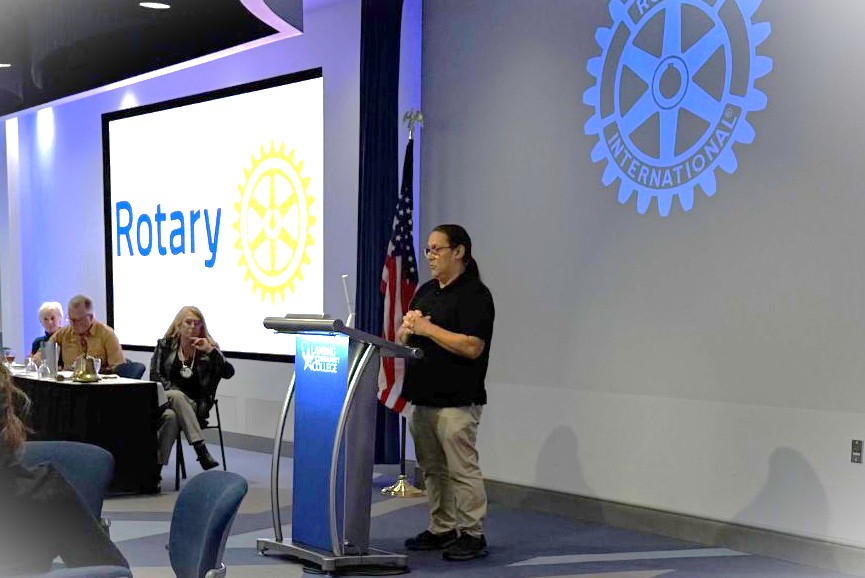 John began by talking about the work of the Nokomis Cultural Heritage Center and one of the biggest misconceptions they are trying to correct: Native Americans are not simply a chapter in an American history textbook. They are here. Their cultures are here. Their governments are here. Their languages and traditions are here.
John explained that Anishinaabe translates roughly to “original people” and refers to Indigenous peoples with deep roots in our region.
Several years ago, a student asked him a question that stuck with him: “Are there any Indians left?”
That question sent John looking through the student’s textbooks. He discovered only a couple of pages about Native Americans, and even the photos being used were of Plains tribes rather than the Woodland peoples who actually lived - and still live - here in Michigan. That helped shape a major part of the Nokomis Center’s mission. Instead of only having students come to them for field trips, the Center increasingly goes directly into classrooms. Last year, they reached approximately 140 classrooms, and they are beginning even more work in local schools this month.
The Center also has an extensive partnership with Michigan State University, working with more than 15 departments to bring Native voices and perspectives into classrooms and university programs. Some of their most interesting work is happening outside of the classroom. MSU has dedicated approximately three-quarters of an acre for a garden where the Center can grow traditional Native plants and crops. Part of that work involves preserving seed varieties, including corn that has been grown by Native communities for generations.
They are also working with MSU Radiology on a traditional medicine garden. John has connected the university with people who have knowledge of traditional medicinal plants, and they hope to expand that garden this coming spring. All of this ties back to something John emphasized throughout his presentation: we tend to teach Native American history as though it stopped a very long time ago.
It didn’t. Native communities are still here, and their cultures survived despite generations of government policies intended to suppress their languages, religious practices and traditions. It was only in 1978 that the federal government formally protected Native Americans’ right to practice their traditional religions through the American Indian Religious Freedom Act.
Today, Michigan is home to more than 240,000 Native American or Alaska Native residents and 12 federally recognized Tribal Nations. Those Tribal Nations are sovereign governments with their own histories, cultures and relationships with the State of Michigan and the United States. Much of what we now know as Michigan was ceded through treaties between Tribal Nations and the United States during the late 1700s and 1800s.
John also talked about some of the darker parts of that history, including the long-term impact of policies designed to separate Native people from their languages and cultures. Native people continue to contribute to Michigan through government, education, art, science, agriculture, culture and countless other areas. The Nokomis Center is working to make sure that when students learn about Native Americans, they understand that they are learning about living cultures and communities - not simply people who existed hundreds of years ago.
John also touched on Indigenous peoples in Canada, including Métis and Inuit communities, as another reminder that there is no single Native American or Indigenous culture. There are many different nations, histories, languages and traditions. If there was one takeaway from John’s presentation, it was probably this: Native American history is not over.
And if our only exposure to it came from a couple pages in a fourth-grade history book, we probably have some catching up to do.
Next week, our speaker will be Dr. Lavonte Heard, founder of Transcendence Performing Arts Center, Inc., a network of schools and studios based right here in Lansing.
Email for Ben Rathbun: Ben@rathbunagency.com